


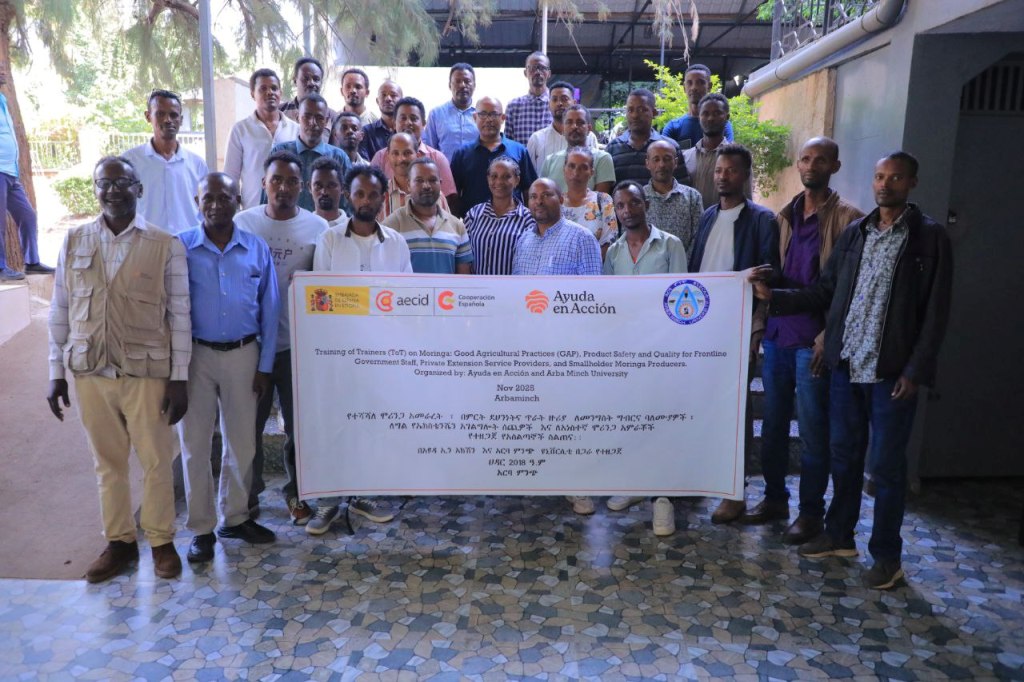
Arba Minch University (AMU), along with Ayuda en Acción, conducted a three-day Training of Trainers (ToT) program on Moringa: Good Agricultural Practices, Product Safety, and Quality. The training brought together frontline government staff, private extension service providers, and smallholder moringa producers from two zones in the South Ethiopia Region. Held from November 25–27 at Lambadina Hotel in Arba Minch, the program aimed to enhance participants’ technical capacity and promote improved moringa cultivation and value-chain practices. Click here to see more photos.
Dr. Teklu Wegayehu, Vice President for Research and Cooperation at AMU, in his opening remarks, noted that the core focus of the ToT was to deepen understanding of moringa, commonly known as the “tree of life” or “miracle tree”, a highly valued herbal plant renowned for its extensive medicinal and non-medicinal benefits. Traditionally, moringa has been used to treat wounds, pain, ulcers, liver and heart diseases, cancer, and inflammation, he noted. Dr. Teklu highlighted the plant’s remarkable drought tolerance and its versatility, noting that nearly all parts of the tree provide essential nutrients and serve diverse purposes beyond leaf consumption.
Dr. Teklu further explained that the participants gained significant knowledge on a wide range of technical and practical topics, including optimal pre-planting and planting techniques for maximizing yields, strategic soil management, diversified moringa product development and quality assurance, effective pest control, and opportunities for secondary income such as establishing bee farms and animal feed operations. He also underscored the importance of building a resilient and environmentally sustainable moringa value chain through climate-smart practices. Concluding his remarks, he expressed confidence that the trainees would apply this knowledge at the grassroots level to improve the livelihoods of communities and bring meaningful change to farmers in the targeted areas and beyond.
Mr. Estefanos Chole, Coordinator of the Innovation in the Development of the Moringa Market System Project for Gamo and Wolaita zones at Ayuda en Acción, stated that the project aims to modernize the global moringa market system while improving the livelihoods of farmers involved in the value chain. He explained that this training, funded by Ayuda en Acción and co-implemented by AMU, is a key component of the initiative, covering Good Agricultural Practices (GAP) from production to product safety, quality assurance, and market readiness. He further noted that frontline staff from the Agriculture and Cooperative bureaus of the two zones participated in this ToT program and will subsequently train 2,000 model farmers selected from three woredas across the project sites.
Dr. Belay Tafa, Coordinator of the Grand and Collaborative Projects Office at Abaya Campus and co-investigator of the Innovation in the Development of the Moringa Market System Project at AMU, noted that moringa is one of the most affordable and reliable sources of good nutrition, with nearly all parts of the tree valued for their essential nutrients. He remarked that AMU is working closely with Ayuda en Acción, and emphasized that the primary objective of this training is to raise awareness and equip trainers with the necessary knowledge and skills on the moringa value chain.
Dr. Zenebe Mekonnen, Agronomist at AMU’s Kulfo Campus, project partner, and one of the trainers, explained that the training was an integral component of the initiative, which spans the entire value chain from moringa plantation to processing and even export development in selected areas: Abala Abaya and Kindo Koyisha woredas in Wolaita Zone, and Mirab Abaya woreda in Gamo Zone of the South Ethiopia Region. Dr. Zenebe added that 30 hectares of moringa have already been planted in each woreda, and the crop requires proper management and continuous follow-up. To ensure this, the training is equipping technicians from the Agriculture and Cooperative bureaus of the two zones with the necessary knowledge, enabling them to effectively support and train farmers at the grassroots level.
One of the trainees, Mrs. Marta Matheows from the Horticulture Department of the Gamo Zone Agriculture Bureau, remarked that moringa is “one of the most useful trees, yet unknowingly forgotten and overlooked by our society.” She noted that the training had greatly benefited her and emphasized that both she and her department should give more attention to this drought-resistant and economically valuable tree, which can play an important role in the country’s economy. Another trainee from the Wolaita Zone Agriculture Bureau’s Horticulture Department added that he had gained substantial knowledge on moringa production and market chain systems, and expressed his commitment to sharing this knowledge with farmers so they can contribute to national economic development.
For more Information Follow us on:-
Website - https://www.amu.edu.et/
Telegram - https://t.me/arbaminch_university
Facebook - https://www.facebook.com/ArbaMinchUniversityccd/
YouTube - https://www.youtube.com/channel/UCOO_nclhMo8M3r74OyPBlVA
Public and International Relations Executive
.