

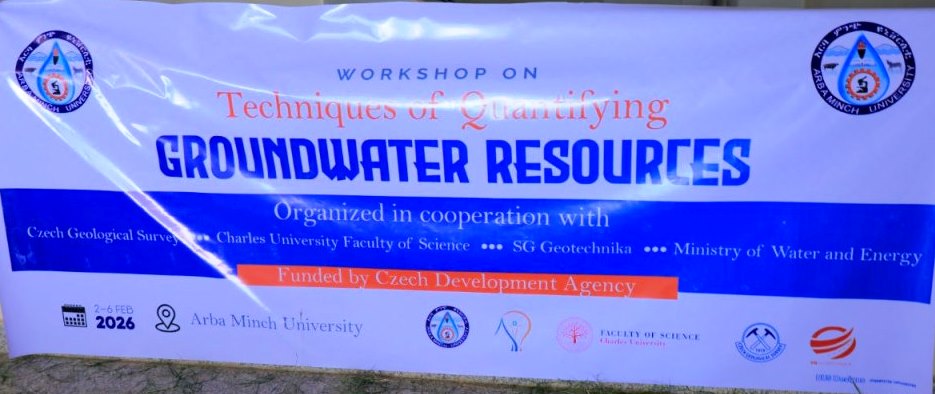
Arba Minch University (AMU) Water Technology Institute (AWTI) held a five-day training workshop on “Techniques of Quantifying Groundwater Resources” from February 2–6, 2026, at AMU Main Campus, bringing together academicians, hydrologists, researchers, practitioners, and representatives from regional and zonal water offices. The workshop was organized in collaboration with the Czech Geological Survey, Charles University Faculty of Science, SG Geotechnika, and the Ministry of Water and Energy of Ethiopia, funded by the Czech Development Agency. It also featured the presentation of 20 scientific papers mainly from the Czech Republic aimed at strengthening knowledge and practice in groundwater resource assessment. Click here to see more photos.
Opening the workshop, AMU President Dr. Eng. Abdella Kemal emphasized that groundwater is one of Ethiopia’s most critical natural resources, underpinning population growth, agricultural transformation, urban expansion, and socio-economic development. He noted that amid climate variability, changing hydrological regimes, and mounting environmental pressures, the demand for accurate groundwater assessment has never been greater, as the country faces rising needs for potable water, domestic use, irrigation, livestock, industry, and ecosystem resilience. Dr. Eng. Abdella stressed that precise identification and quantification of groundwater resources are essential to ensuring water security, food security, and climate resilience. He further added that the workshop comes at a timely moment for the scientific community to adopt emerging tools, advanced technologies, and new conceptual frameworks, while expressing appreciation for the collaboration as a strong example of international academic partnership.
Welcoming international guests and national participants, AWTI Scientific Director Dr. Tamiru Tesseme highlighted that groundwater is the world’s largest source of liquid freshwater after glaciers and polar ice caps and supplies a major share of global domestic and irrigation water. He noted that groundwater provides about 43 percent of irrigation water worldwide and more than half of drinking water, while in Ethiopia over 80 percent of domestic water supply systems rely on groundwater despite less than five percent of the country’s estimated potential being utilized for agriculture. Dr. Tamiru added that the five-day training combines foundational principles with advanced techniques, including 3D geological modeling, recharge assessment, modern drilling technologies, hydrogeological modeling, machine learning applications, and hands-on GIS and remote sensing, underscoring that this integrated approach is key to strengthening professional capacity and translating science into practice.
Professor Kryštof Verner, Lead Researcher and Hydrologist at the Czech Geological Survey, said the workshop is part of an international project focused on identifying and evaluating groundwater resources in Ethiopia. He noted that the project is being implemented mainly in the Sidama Region and Gamo and Goffa zones, with recent activities also in Wolaita Zone, and involves experts from Ethiopia, the Czech Republic, Austria, the United Kingdom, and the United States. Professor Verner explained that the team assesses groundwater using both conventional methods such as drilling and surface mapping and innovative approaches, including artificial intelligence and machine learning, to address data scarcity. He added that the workshop particularly emphasizes applying machine learning to analyze groundwater levels and yields, which are critical parameters for local planning and water resource management.
Dr. Samuel Dagalo, senior researcher and project coordinator at AMU, explained that groundwater is the largest source of liquid freshwater on Earth after glaciers and polar ice caps and supplies a substantial share of global domestic water demand. Though largely hidden underground, he noted, groundwater plays a vital role in the hydrological cycle and societal well-being, providing about 43 percent of global irrigation water and more than half of the world’s drinking water. In Ethiopia, Dr. Samuel underscored, over 80 percent of developed domestic water supply systems depend on groundwater, despite less than five percent of the country’s estimated groundwater potential being utilized for agriculture.
The workshop brought together hydrogeologists from the Ministry of Water and Energy of Ethiopia, Sidama Regional State, and the Gamo, Basketo, Gofa, and Wolaita Zones water offices, alongside staff of the Department of Geology and the Water Technology Institute at AMU, including PhD students in Groundwater Engineering, Water Supply, and Environmental Engineering, to build capacity in advanced groundwater assessment, modeling, and machine-learning–supported resource evaluation.
For more Information Follow us on:-
Website - https://www.amu.edu.et/
Telegram - https://t.me/arbaminch_university
Facebook - https://www.facebook.com/ArbaMinchUniversityccd/
YouTube - https://www.youtube.com/channel/UCOO_nclhMo8M3r74OyPBlVA
Public and International Relations Executive