

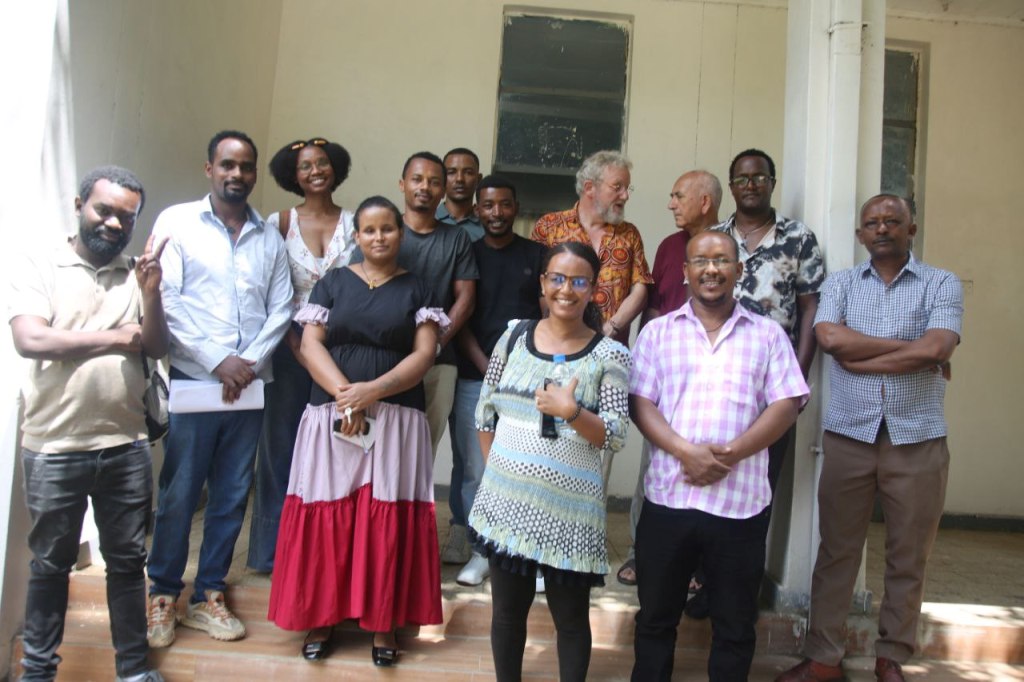
Arba Minch University (AMU) College of Agricultural Sciences, Department of Forestry, in collaboration with a Belgium-based Senior International Expert, organized a public lecture on Agroforestry and Sustainable Land-Use Systems on February 25, 2026, at Kulufo Campus. The event brought together faculty members, researchers, and students from the Department of Forestry, along with other invited participants. Click here to see more photos.
Speaking at the opening session, College of Agricultural Sciences Dean Dr. Degife Asefa expressed his appreciation to Professor Patrick Worms for his visit and contribution. He emphasized that agroforestry is no longer viewed merely as the integration of trees into farming systems, but as a scientifically grounded land-use strategy that strengthens ecological resilience, improves rural livelihoods, and supports climate change mitigation and adaptation. By deliberately combining woody perennials with crops and/or livestock within the same management unit, he noted, agroforestry enhances nutrient cycling, improves soil structure, promotes carbon sequestration, conserves biodiversity, and regulates microclimates.
Dr. Degife further underscored that in regions such as South Ethiopia, where land degradation, declining soil fertility, and climate variability pose serious challenges, sustainable land-use systems are essential. He noted that approaches such as conservation agriculture, integrated watershed management, and coffee- or fruit-based agroforestry landscapes demonstrate how agricultural productivity and environmental sustainability can complement each other. Emphasizing the significance of the lecture, he added that it would provide insights into the ecological foundations, design and management of agroforestry systems, as well as their socioeconomic dimensions and emerging research trends. He also stressed that the responsibility of researchers, practitioners, and students goes beyond academic discussion, calling for the translation of knowledge into practical actions that promote productive, climate-resilient, and environmentally sustainable land-use systems for future generations.
Professor Patrick Worms of Belgium, representing the Center for International Forestry Research and World Agroforestry (CIFOR–ICRAF), noted that lectures of this kind are important because professionals often operate within their own legal and geographical contexts. Exposure to international experiences, he explained, helps broaden perspectives by demonstrating how agroforestry is practiced around the world and why it is increasingly recognized as an effective approach to sustainable land management. He added that CIFOR–ICRAF works to transform scientific knowledge into practical action to unlock the power of trees, forests, and agroforestry landscapes for planetary health and human well-being.
Mr. Bayisa Bekele, Head of the Department of Forest Science and coordinator of the event, noted that the department has been facing challenges in attracting students, as many tend to overlook forestry programs. He added that this situation has at times discouraged staff and prompted some to seek opportunities elsewhere. In this regard, he stated that the seminar was organized to motivate and energize both staff and students, while deepening their understanding of the global significance and impact of agroforestry.
Finally, the event concluded with an interactive session that allowed participants to share their experiences, provide feedback, and engage in constructive dialogue.
For more Information Follow us on:-
Website - https://www.amu.edu.et/
Telegram - https://t.me/arbaminch_university
Facebook - https://www.facebook.com/ArbaMinchUniversityccd/
YouTube - https://www.youtube.com/channel/UCOO_nclhMo8M3r74OyPBlVA
Public and International Relations Executive