

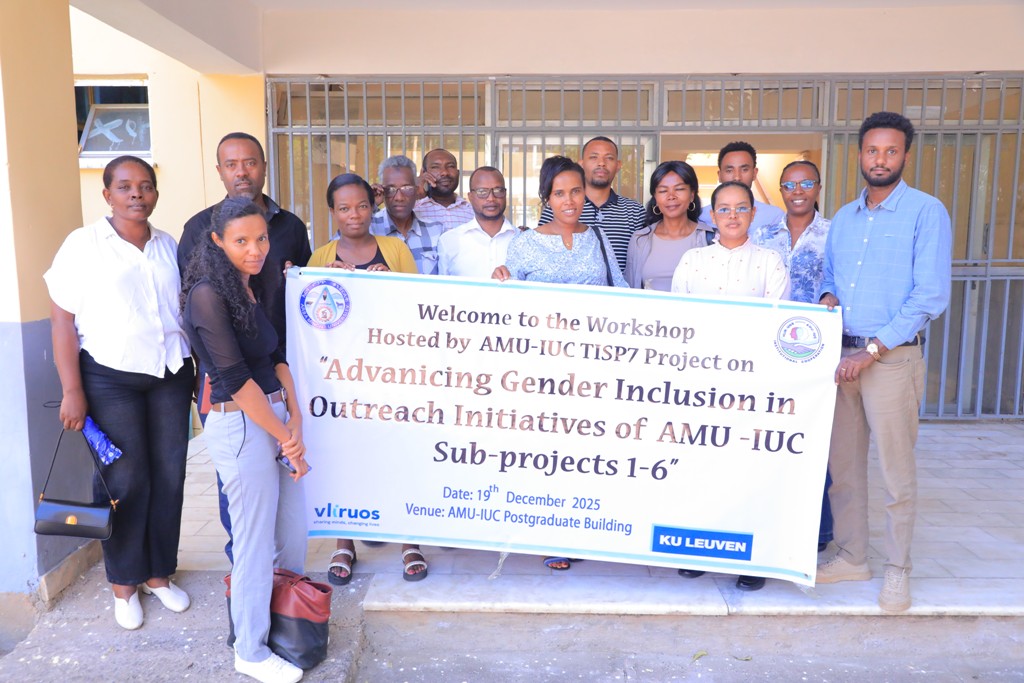
Arba Minch University (AMU), through the AMU-IUC Project, successfully conducted a one-day workshop under the TISP7 project focusing on advancing gender inclusion in outreach initiatives with leaving no one behind principle across sub-projects I to VI. The workshop held at AMU-IUC Video Conference Room, main campus, on 19th December 2025, brought together project leaders, coordinators, and gender focal persons to review progress, identify gaps, and agree on strategic actions for the remaining project period. Click here to see more photos.
In his keynote address, Dr. Fassil Eshetu, Project Manager and Chairperson, underscored that gender remains a transversal priority across all six AMU-IUC pillars. Reflecting on lessons learned from Phase I, he noted that, while significant technical achievements had been realized, the absence of clearly documented gender baselines limited effective impact assessment. He emphasized that, for Phase II, establishing robust baselines and systematically tracking incremental progress is mandatory to meet international evaluation standards, strengthen partnerships, and ensure long-term sustainability.
Dr. Fassil called for a deliberate shift from activity-based reporting to impact-oriented measurement. He announced plans for a specialized training session aimed at supporting project leaders and PhD candidates in extracting or establishing gender-sensitive baselines from existing research data. He further indicated that each sub-project will be required to develop standardized gender indicators to measure impact and produce harmonized reports aligned with international standards and the Sustainable Development Goals.
Dr. Genaye Tsegaye, TISP7 Project Leader, outlining the workshop’s central objective, said, strengthening collaboration and ensuring that gender inclusion is systematically integrated and clearly documented across research, training, and community outreach activities. She highlighted the importance of producing visible, data-driven evidence to demonstrate impact at both university and community levels.
Presenting an overview of TISP7 interventions, Dr. Genaye noted key achievements at the university level, including the establishment of day-care centres at the Kulfo and Abaya campuses, which support female staff participation in research and PhD programmes. She affirmed that targeted capacity-building initiatives for PhD candidates on gender integration, the drafting of a comprehensive Gender Policy currently awaiting Senate approval, and on-going gender analysis of postgraduate curricula to ensure inclusivity. According to the sub-project leader, at the community level, the workshop reviewed the outcomes of the “Girls in the Environment” campaigns implemented in local schools and revealed that the initiatives promote girls’ education, challenge socio-cultural barriers, and encourage multi-stakeholder engagement. Supported by awareness materials produced in local languages, the campaigns have contributed to increased community dialogue and enhanced motivation among female students.
Providing a detailed follow-up on gender mainstreaming across the sub-projects, Mrs. Bayush Tesfaye, AMU-IUC Outreach and Gender Coordinator, reported notable progress in areas such as ICT laboratories supporting girls’ digital literacy under Sub-Project 1, maternal health and nutrition interventions under Sub-Project 3, and community-based land rehabilitation initiatives under Sub-Projects 4 and 6. However, a critical challenge related to the absence of uniform, gender-disaggregated baseline data across several sub-projects continues to limit the ability to demonstrate measurable impact, she highlighted.
The workshop concluded with a shared understanding that its objectives had been successfully achieved, underscoring the value of active engagement and constructive contributions throughout the discussions. With the planned capacity-building support, all sub-projects are expected to produce gender-inclusive, evidence-based reports that clearly demonstrate measurable impact. Reflections from sub-project representatives highlighted strong inclusive practices across the interventions, while also emphasizing the need for enhanced documentation and systematic evidence generation to substantiate outcomes.
For more Information Follow us on:-
Website - https://www.amu.edu.et/
Telegram - https://t.me/arbaminch_university
Facebook - https://www.facebook.com/ArbaMinchUniversityccd/
YouTube - https://www.youtube.com/channel/UCOO_nclhMo8M3r74OyPBlVA
Public and International Relations Executive