

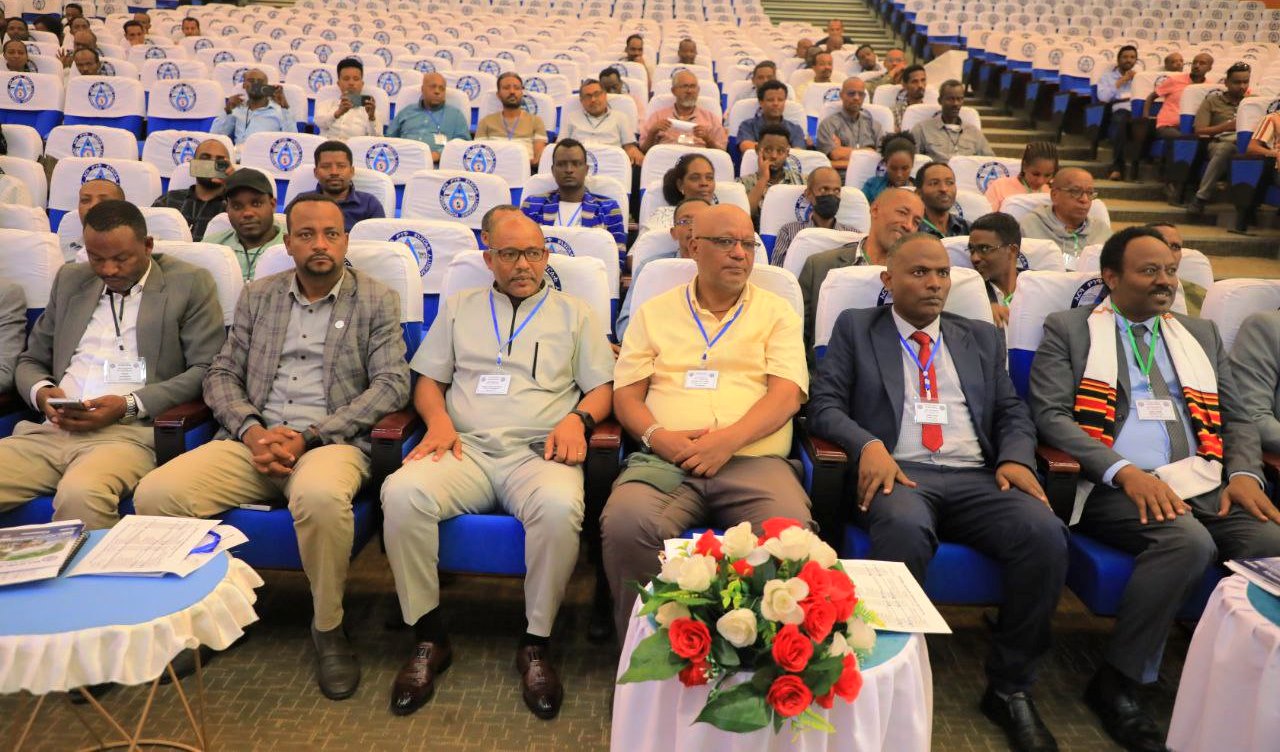
Arba Minch University (AMU) marked the10th Annual Community Engagement Day on December 5, 2025, at the Main Campus Hall, bringing together a broad range of stakeholders to reflect on annual achievements of the year 2024-2025 under the theme “Let’s serve the community at every opportunity.” The event highlighted AMU’s sustained commitment to community-centered service through keynote speeches from senior officials, a vibrant exhibition of research-driven initiatives, and a forthcoming panel discussion intended to deepen clear understanding collaborative community engagement approaches. Click here to see more photos.
Transitioning to the national perspective, Dr. Serawit Handiso, Executive Director of Research and Community Engagement at the Ministry of Education, delivered the day’s central message, challenging the long-held notion of universities as isolated centers of knowledge and calling for a shift toward open, community-embedded institutions. “The philosophy and vision of our time is for the university to become an open campus and a living ecosystem where knowledge flows in both directions,” he said. Dr. Serawit outlined the Ministry’s ongoing reform agenda, which includes moving from institutional isolation to coordinated centralization, integrating community-engaged education into academic credit systems, and undertaking structural reforms that enhance participation and long-term sustainability. “The goal is to evolve from being a prominent institution in the community to becoming an indispensable partner,” he emphasized, urging universities to forge partnerships built on shared purpose, collective progress, and the transformative power of co-created knowledge.
Dr. Demis Admasu, Gamo Zone Administrator and member of the AMU Administration Board, underscored the urgent need to deepen university–community linkages, noting that initiatives attracting international research grants and global funding remain vital; “Such accomplishments are not just institutional wins, yet they are shared triumphs for the community and the nation,” he said, stressing that Community Engagement Day reaffirms the university’s role as an integral part of the society rather than an isolated academic institution. Aligning his remarks with national priorities, Dr. Demis referenced Prime Minister Abiy Ahmed’s emphasis on key economic sectors, agriculture, industry, mining, tourism, and ICT, within ongoing homegrown reforms. For Ethiopia to achieve lasting growth, he asserted, universities must take the lead in producing research, innovation, and skilled professionals that directly address national challenges. “Our future depends on bridging research with practice and connecting universities more meaningfully with the communities they serve,” he emphasized.
Dr. Bogale Gebremariam, Vice President for Academic Affairs and President’s Delegate, reaffirmed AMU’s readiness to engage in meaningful partnerships and noted that the university is transitioning toward autonomy to enhance research capacity and attract broader international, national and regional cooperation. Emphasizing the university’s longstanding commitment to its community, he stated that AMU’s mission in teaching and research is fundamentally rooted in serving society. Regarding the community engagement mission of the university, over the years, AMU has undertaken numerous initiatives designed to improve the lives and well-being of the local community, working closely with them to ensure that its efforts are relevant, impactful, and aligned with shared goals. Celebrating Community Day each year reflects AMU’s focus on its mission, its commitment to collaboration, and its drive to achieve results through active, engaged participation from the community. Dr. Bogale stressed that, as always, the university seeks to be trusted by the community and to work alongside it effectively, sustaining its achievements through capacity-building trainings, projects, workshops, and the application of accumulated experience, ensuring continuous and high-quality engagement for lasting impact.
Echoing on the same commitment, Dr. Teklu Wegayehu, Vice President for Research and Community Engagement at AMU, said that the university’s expanding community-focused projects, funded both through partnerships and the institution’s regular budget, with initiatives steadily increasing in scale and impact. “From the standpoint of institutional autonomy, we are strengthening collaborative efforts,” he remarked. “Our community engagement is closely linked with thematic research, which not only advances knowledge but also delivers practical, real-world solutions.” Dr. Teklu noted. He cited specific studies on precious metal extraction and mineral deposits in localities such as Gerese, Melokoza, and Kolme cluster, which have identified resources with significant potential for development. “The university will intensify research to boost internal revenue and accelerate regional and national development,” he affirmed, positioning AMU’s work as central to Ethiopia’s broader transformation agenda.
Further highlighting AMU’s initiatives, Dr. Tolera Seda, Director of the Community Engagement and Industry Linkage Directorate, recalled the university’s evolution from traditional service models to deeper community engagement, emphasizing five levels of participation: informing, consulting, involving, collaborating, and empowering. He showcased the major achievements from the 2024-25 budget year, including watershed development, tree planting, renewable energy projects installation, health services, free legal aid, forensic crime partnerships, and educational support for 51 schools in Gamo Zone, along with cattle cholera prevention and mining sector collaborations. He also mentioned undergoing efforts of capacity building of the university’s hospital for community benefit and research-based initiatives, and protection of the ecosystems on Lake Chamo and Lake Abaya, illustrating AMU’s integrated approach to research, service, and sustainable development.
Following the addresses, a dynamic panel discussion moderated by Dr. Serawit Handiso, Dr. Teklu Wegayehu, and Mr. Degu Desalegn engaged participants on practical strategies for community engagement. The dialogue focused on technology transfer, need-based project design, and strengthening support for local secondary schools, generating lively exchanges and actionable recommendations for deeper collaboration. The commitment to tangible partnerships was further cemented when Dr. Bogale Gebremariam, AMU Vice President for Academic Affairs and the delegate for the president, and Mr. Abayneh Abera, Deputy Commissioner of the South Ethiopia Regional State Risk Prevention and Preparedness Bureau, signed an MoU formalizing cooperation in risk prevention, disaster preparedness, and community education, leveraging AMU’s research to enhance regional resilience.
The 10th Annual Community Engagement Day successfully reinforced AMU’s role as an indispensable partner in community-driven development, fostering dialogue, exploring solutions, and strengthening university-community ties. Beyond honoring past achievements, the event set the stage for sustained, impactful partnerships, affirming AMU’s position as a cornerstone of regional and national development.
For more Information Follow us on:-
Website - https://www.amu.edu.et/
Telegram - https://t.me/arbaminch_university
Facebook - https://www.facebook.com/ArbaMinchUniversityccd/
YouTube - https://www.youtube.com/channel/UCOO_nclhMo8M3r74OyPBlVA
Public and International Relations Executive