


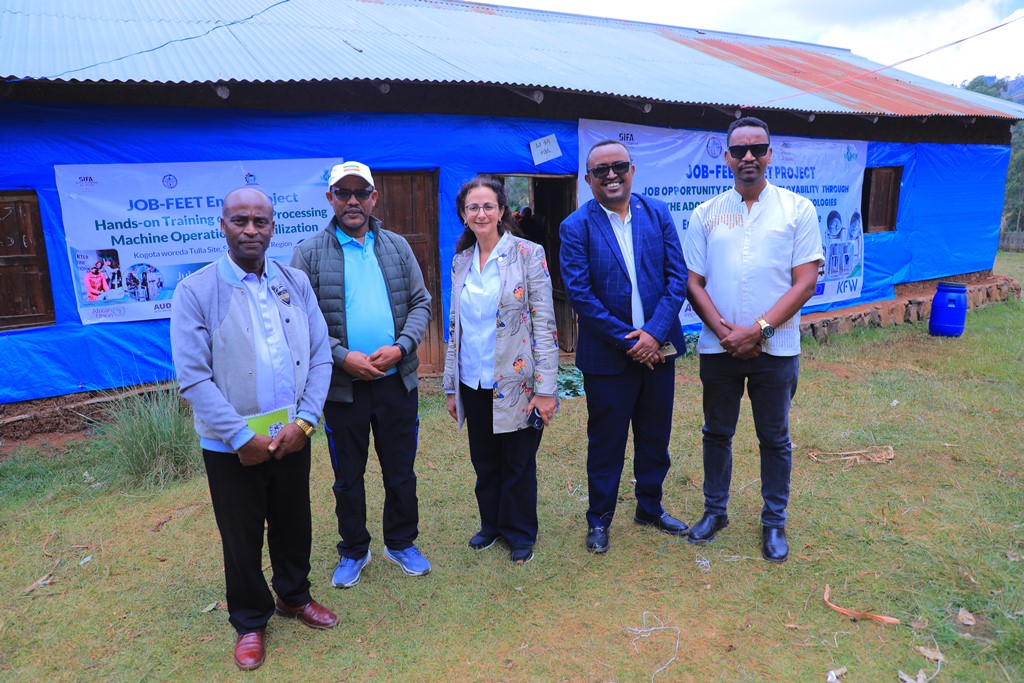
Arba Minch University–Skills Initiative for Africa (AMU-SIFA) project team, led by Ms. Muna Ahmed from KfW Headquarters, Germany, and comprising Dr. Ayele Gizachew, Project Country Director; Dr. Teklu Wegayehu, AMU Vice President for Research and Cooperation; Dr. Wondwosen Jerrene, Project Coordinator; Mr. Workneh Hailemichael, Vice Dean of Arba Minch Polytechnic and Satellite Institute and Technology Transfer and Industry Extension Coordinator representing the project partner; and other project members, visited enset seedling propagation and processing sites in Dorze, Chencha, and Qogota Tulla on July 15, 2026. During the visit, the team reviewed the progress of the newly established project sites, showcasing end-to-end enset value chain interventions ranging from disease- and pest-free seedling propagation and production to traditional and modern enset processing technologies and fiber craftsmanship. Click here to see more photos.
Speaking during the site visit, AMU Vice President for Research and Cooperation, Dr. Teklu Wegayehu, described the AMU-SIFA project as a unique initiative because of its end-to-end focus on the enset value chain, its implementation across three regional states, and its strong public–private partnership approach. He noted that the project was initially designed to create employment opportunities for more than 1,500 youth and women through the establishment of 81 enterprises and to achieve its four major milestones within 18 months. However, recognizing the time-intensive nature of the interventions, the project team successfully negotiated with the funding institutions to extend the implementation period to complete by two years, enabling the effective accomplishment of all planned milestones. Commending the successful implementation of the first three milestones, Dr. Teklu stated that the project has so far been implemented productively and expressed confidence that the remaining milestone will also be completed with the same level of commitment while ensuring effective sustainability and well-defined exit strategies.
Briefing participants on the project's implementation progress and the outcomes of the site visit, AMU-SIFA Country Director, Dr. Ayele Gizachew, said that the project is an African Union initiative funded by the German Development Bank (KfW) and implemented by the African Union Development Agency (AUDA-NEPAD). He noted that AMU-SIFA is one of four national projects implemented under the initiative and has distinguished itself by delivering substantial results and implementing large-scale interventions despite its relatively modest financial support. Dr. Ayele further stated that the project has demonstrated the immense potential of enset for food security, environmental sustainability, and livelihood improvement. While creating employment opportunities for more than 1,500 women and youth through enset-based enterprises and processing technologies, he stressed that the project's innovative model should be scaled up to benefit the more than 20 million people who depend on enset and to expand sustainable opportunities across enset-growing areas.
Project Coordinator, Dr. Wondwossen Jerene, said the AMU-SIFA project has made significant progress in implementing its major milestones across the three regional states. He noted that key interventions, including disease-free enset seedling propagation, fiber-crafting training, food production, and the production and distribution of enset-processing machine technologies, are well underway. Dr. Wondwossen said the site visit enabled representatives of the funding institutions to witness the project's on-the-ground achievements and the immense potential of enset for food security, climate resilience, environmental sustainability, and livelihood improvement. He added that these results strengthen development partners' confidence and pave the way for future collaboration. Despite the modest SIFA Window III grant, the project has demonstrated remarkable impact by easing women's labor-intensive enset processing through innovative technologies and creating sustainable employment opportunities for women and youth.
Project partner, Mr. Workneh Hailemichael, Vice Dean of Arba Minch Polytechnic and Satellite Institute and Technology Transfer and Industry Extension Coordinator, said that the institute, in partnership with AMU and Lucy Enset, is responsible for producing prototype enset-processing technologies and providing technology and fiber-processing training across the project's three regional states. He noted that the project is making a significant impact by reducing the labor-intensive burden of enset processing on women while creating employment opportunities for many community members. Expressing his satisfaction with the partnership, Mr. Workneh said he was pleased to contribute to a project that delivers meaningful socio-economic benefits and improves livelihoods.
Mrs. Muna Ahmed, Portfolio Manager for TVET Projects with the African Union at KfW Headquarters in Frankfurt, Germany, expressed her appreciation for the project's achievements, particularly the innovative enset-processing technologies that ease the labor-intensive burden traditionally borne by women. She commended the project's rapid progress, the commitment of the trainers, the enthusiasm of the women trainees, and the well-selected implementation sites. Congratulating Arba Minch University and its partners for their excellent work, Mrs. Muna emphasized that sustaining the project's achievements is essential to ensuring long-term socio-economic benefits. From a donor's perspective, she noted, the project's sustainability, economic impact, and contributions to school feeding add significant value. She further described enset as a unique crop whose gluten-free food products and multiple uses deserve wider recognition and dissemination beyond Ethiopia.
Mrs. Mihret Abera, Site Coordinator; Mr. Asegid Alemu, Machine Trainer; Mr. Abebe Bashe, Field Coordinator and Trainer; and Mr. Manaye Mamo, Seedling Site Coordinator, briefed the visiting delegation on their respective areas of responsibility and the progress of project implementation. The trainees expressed their satisfaction with the machine training and technological innovations, noting their positive contribution to livelihood improvement and employment opportunities. They also called for scaling up the project to reach more enset-growing communities, emphasizing its potential to expand the benefits of enset, improve women's livelihoods, and further reduce the labor-intensive nature of traditional enset processing.
Arba Minch University
Spring of Wisdom!
For more Information Follow us on:-
Website - https://www.amu.edu.et/
Telegram - https://t.me/arbaminch_university
Facebook - https://www.facebook.com/ArbaMinchUniversityccd/
YouTube - https://www.youtube.com/channel/UCOO_nclhMo8M3r74OyPBlVA
Public and International Relations Executive