


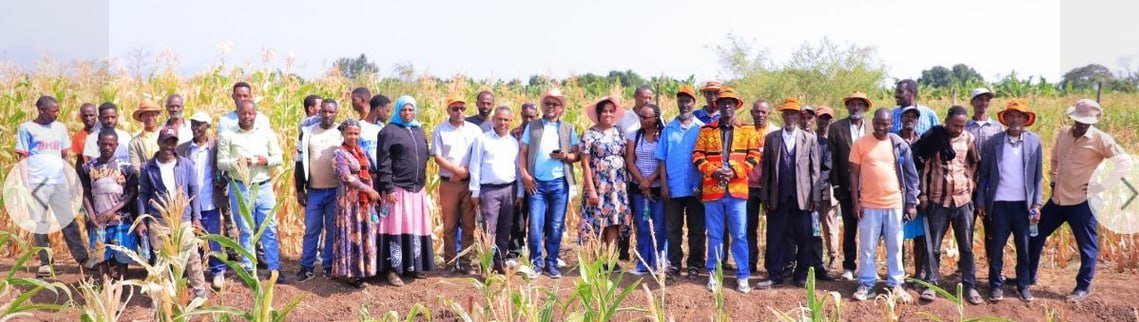
Arba Minch University (AMU) - Institutional University Cooperation (IUC) Sub-Project IV program conducted an insightful field visit to a demonstration site showcasing practical soil-salinity rehabilitation solutions on December 3, 2025. Organized by AMU-IUC Sub-Project IV, the visit took place at the Sile-Elgo Lowland, one of the most severely salt-affected farming areas in the Southern Main Ethiopian Rift Valley, located in the Sile-Elgo catchment of Shelle Mella Kebele. The event illustrated how research outputs are being transformed into workable practices that enhance soil productivity and promote sustainable land use across the Abaya–Chamo sub-basin. Click here to see more photos.
Dr. Teklu Wegayehu, AMU’s Vice President for Research and Cooperation, opening the event and welcoming the participants, stressed that the soil is an irreplaceable resource which central to food production, biodiversity, water regulation, and climate mitigation, yet it is rapidly degrading due to pollution, deforestation, poor land management, urbanization, and the drying effects of climate change. Despite these pressures, he noted, restoring soil health is still possible, and AMU is committed to tackling this national challenge. Dr. Teklu highlighted key rehabilitation techniques for saline soils, including flushing salts below the root zone, improving drainage, and applying compost and gypsum to replace sodium with calcium. He also pointed to complementary practices such as mulching, using salt-tolerant crops, and careful irrigation management to prevent further salt buildup. The demonstration site, he emphasized, showcases these practical, science-based solutions and serves as a valuable learning platform for farmers and the wider community.
Dr. Fassil Eshetu, AMU-IUC Project Manager and moderator of the event, explained that the AMU–IUC partnership is strongly focused on empowering PhD students. However, he noted that many researchers struggle to translate their findings into practical solutions due to limited funding. To bridge this gap, the project provides seed money to help PhD researchers implement affordable, community-oriented interventions that address real problems at local and national levels. Dr. Fassil commended the Sub-Project IV team for their exceptional work, noting that they had turned a seemingly impossible challenge into a meaningful impact by engaging local communities and applying scientific methods to rehabilitate severely salinized soils and restore soil health.
Dr. Tizita Endale, AMU water resources and soil science researcher and leader of AMU-IUC Sub-Project IV, explained that the project aims to translate research findings into practical, on-the-ground solutions. After identifying severe soil salinization in the area and its causes, her team carried out deep tillage to break saline-sodic layers, installation of standard drainage channels, application of farmyard manure, gypsum, and farmyard manure and gypsum combinations, followed by flushing the soil with good-quality irrigation water to wash salts downward.
As treated soils showed major improvements, she said, maize was successfully planted on land that had previously been unable to grow even weeds. She highlighted that the results were rapid and remarkable: soil salinity decreased, water infiltration improved, and soil structure and biological activity began to recover. Dr. Tizita emphasized that the Sile-Elgo demonstration site now serves as a living laboratory where research, community engagement, and institutional support converge to address environmental challenges. Implemented under AMU-IUC Sub-Project IV, Restoring Saline and Sodic Soils, the initiative provides a scalable model for enhancing soil health, agricultural productivity, and rural livelihoods across salinity-affected areas.
Mr. Solomon Dera, Shelle Mella Kebele administrator, expressed admiration for the project’s achievements, noting that the community had learned how to maintain healthy soil using locally produced compost, farmyard manure, drainage channels, and clean irrigation water to flush salts. He added that farmers around the site had applied these practices and were already harvesting good yields. Mr. Solomon emphasized the importance of expanding this practical soil rehabilitation approach to other kebeles facing similar challenges to improve farmers’ livelihoods.
Local officials, extension workers, and community representatives praised the visible transformation at the demonstration site, noting that many residents had already adopted the practices on their own fields. They highlighted that the research-based solutions are practical, affordable, and easily replicable.
For more Information Follow us on:-
Website - https://www.amu.edu.et/
Telegram - https://t.me/arbaminch_university
Facebook - https://www.facebook.com/ArbaMinchUniversityccd/
YouTube - https://www.youtube.com/channel/UCOO_nclhMo8M3r74OyPBlVA
Public and International Relations Executive