- Details
Arba Minch University
Arba Minch Institute of Technology
Research and Community Engagement Directorate office
The office of the Research and Community Engagement Directorate (RCED) is a core academic support unit of the Arba Minch Institute of Technology (AMiT), Arba Minch University (AMU). The Directorate is accountable to the Scientific Director of the Institute and is responsible for coordinating, promoting, and overseeing research, publication and community engagement activities within the Institute.
RCED plays a pivotal role in fostering a culture of high-quality, demand-driven, and problem-solving research and community engagement that aligns with national and regional development goals, as well as the vision and mission of Arba Minch University.
Vision
To develop a flourishing research and community engagement culture facilitated by state-of-the-art infrastructure and efficient support services, enabling the institute to become one of the top five nationally established premier institutes of technologies for research and community service in Ethiopia by 2023 E.C (2030 G.C).
Mission
To establish a sustainable culture of institutional systems that help the institute conduct country-oriented problem-solving and demand-driven intensive research and projects towards applying the knowledge and technologies generated thereof to the serve the community’s need in fostering the national development process.
Key Objectives
· Promote high-quality, demand-driven, and problem-solving research.
· Strengthen technology-based community engagement and outreach.
· Enhance research management, dissemination, and utilization of outputs.
· Foster national and international research collaboration and partnerships.
· Encourage innovation, technology transfer, and applied research.
Duties and Responsibilities
· Plan, organize, facilitate, manage, monitor, and report on the Institute’s research and community engagement activities.
· Ensure proper implementation and administration of research and project funds.
· Prepare research themes and procedures relevant to the Institute in consultation with key stakeholders+.
· Encourage and provide leadership to the development and adaptation of appropriate technologies by ensuring all research and projects are demand-driven and focused on solving real community problems
· Provide strategic and operational recommendations to promote research and community engagement activities within the Institute.
· Identify, promote, and lead the development of multidisciplinary and interdisciplinary research activities in consultation with relevant offices.
· Disseminate research results through conferences, workshops, demonstrations, and publications.
· Establish expert panels to seek external funding and grants.
· Supervise the performance of validation workshops for completed research and projects.
· Maintain proper documentation of research projects, results, and outputs.
· Ensure that workloads, incentives, and recognition for researchers are provided according to established guidelines.
· Facilitate regular seminars, workshops, and panel discussions.
· Solicit additional research funds from external sources.
· Encourage researchers to disseminate their findings through publication in reputable national and international journals, as well as through presentations at relevant workshops, symposia, and similar events.
· Ensure that breaches and misconduct are addressed based on established guidelines.
· Perform any other duties as assigned by the Scientific Director.
Coordination Office’s:
1. Research & Publication Coordination Office
2. Community Engagement Coordination Office
Contact Information
Director, Research and Community Engagement Directorate
Addisu Mulugeta (MSc)
Assistant Professor, Computer Science
Mobile: +251 910 439 239
Email:
- Details
AMiT Institute Industry Linkage and Technology Transfer (IIL-TT) Directorate
The AMiT IIL-TT Directorate Office serves as the central hub for fostering collaboration between academia and industry, promoting innovation, and ensuring the practical application of research. Our mission is to bridge the gap between theoretical knowledge and real-world solutions by facilitating internships, technology transfer, and strategic partnerships.
Key Responsibilities of the Office
- Industry Collaboration & Partnership Building
- Identifies and establishes strategic partnerships with industries relevant to AMiT’s academic and research focus.
- Negotiates and oversees the implementation of Memoranda of Understanding (MoUs) with stakeholders.
- Develops and maintains collaborations to turn technology-based ideas into viable business ventures.
- Student & Staff Capacity Development
- Coordinates and enhances student internship and staff externship/industrial attachment programs.
- Facilitates staff allocation for mentoring interns and ensures proper guidance and evaluation.
- Technology Transfer & Innovation Promotion
- Facilitates the transfer of knowledge, inventions, and technologies developed by AMiT staff and students to the industry.
- Promotes and disseminates research outputs through media, conferences, brochures, and policy briefs.
- Supports the continuation of successful projects toward technology transfer and business incubation.
- Creates a conducive environment to motivate and involve both staff and students in technology transfer activities.
- Program Management & Strategic Support
- Monitors and evaluates all institute-industry linkage and technology transfer activities.
- Prepares strategic plans, action plans, program budgets, reports, and operational guidelines.
- Conducts tracer studies to assess the impact of transferred and incubated technologies.
- Organizes awareness workshops, seminars, and capacity-building trainings on IIL-TT topics.
- Grant Acquisition & Resource Mobilization
- Actively seeks national and international grants to support joint research and technology transfer initiatives.
CONTACT US:
AMiT IIL &TT Directorate
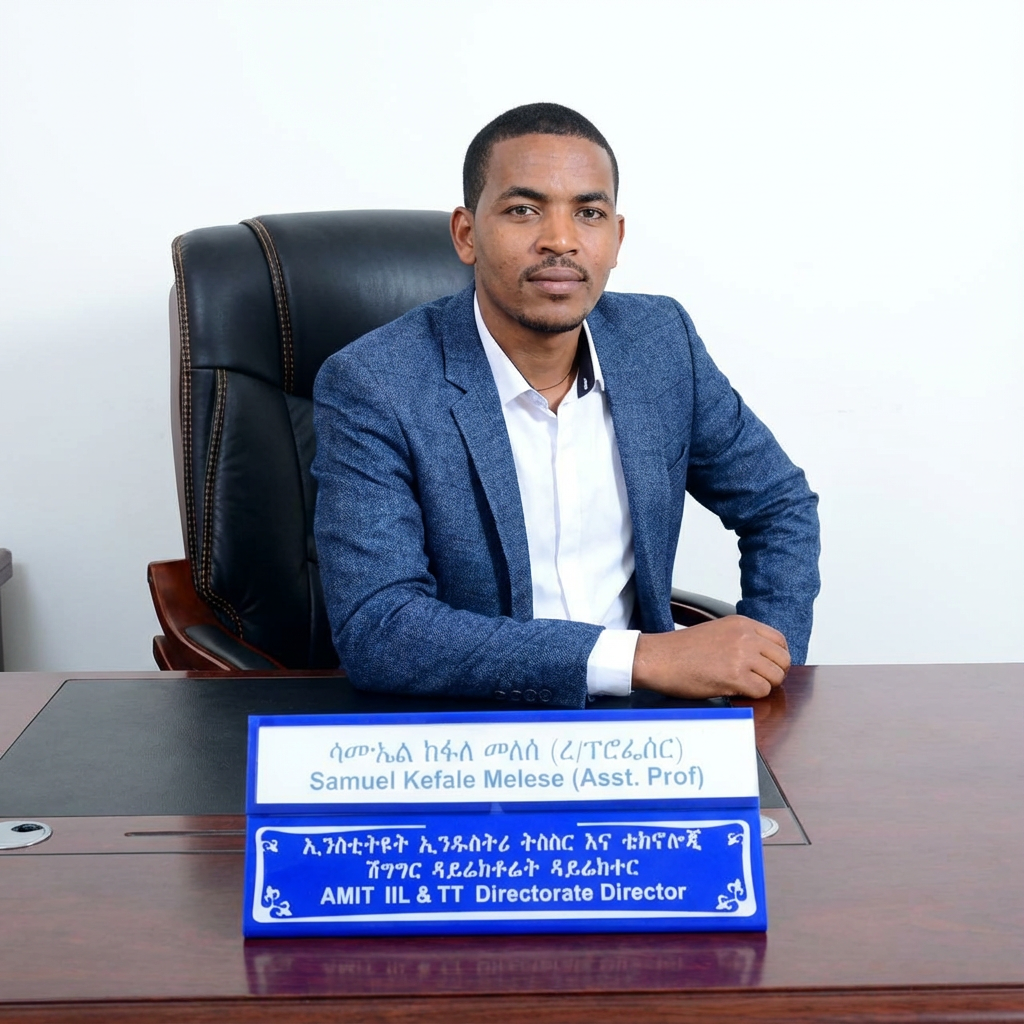
Director: - Samuel Kefale
Phone: - +251923530037
P.O. Box 21
Arba Minch University
Email: -
E-mail office:
Click her to the see updates on the office activity
- Details
 |
 |
|
Electrical Power Engineering Chair Head Email: Office: New AMiT Faculties Building Phone No: +251910895881 Electrica Power Engineering: focuses on power generation, transmission, distribution, and utilization, covering power systems, smart grids, and high-voltage technologies. It addresses critical challenges like grid stability, renewable integration, and industrial electrification. The field combines traditional power plants with modern energy storage and sustainable solutions. Power engineers ensure reliable, efficient electricity supply while advancing global energy infrastructure. This discipline is essential for tomorrow’s energy transition and technological innovation. Introduction: The Chair leads academic and research excellence in power systems, overseeing curriculum development, faculty growth, and industry partnerships. Focused on power generation, transmission, smart grids, and renewable integration, the role drives innovation in sustainable energy technologies. Through cutting-edge research and strategic collaborations, the Chair ensures the department remains globally competitive while preparing graduates for evolving energy sector challenges.
|
|
Miss. Betsega Yosef Erchafo Industrial control and instrumentation Engineering Chair Head Email: Office: New AMiT Faculties Building Phone No: +251910054056 Industrial Control and Instrumentation Engineering focuses on the design, development, and implementation of control systems and instrumentation used in manufacturing, process industries, and automation. It covers areas such as sensors and measurement technologies, control theory, process automation, robotics, and industrial communication networks. This discipline addresses critical challenges like precision control, system integration, safety, and real-time monitoring. It combines traditional control techniques with modern innovations like AI, IoT, and smart systems. Engineers in this field ensure efficient, reliable, and intelligent operation of industrial systems, playing a vital role in advancing automation and digital transformation across sectors. The Chair leads academic and research excellence in industrial control and instrumentation, overseeing curriculum development, faculty advancement, and industry collaboration. Focused on automation, control systems, smart manufacturing, and industrial IoT integration, the role fosters innovation in intelligent systems and advanced instrumentation. Through cutting-edge research and strategic partnerships, the Chair ensures the department remains at the forefront of global developments while equipping graduates to tackle complex challenges in industrial automation and control.
|
 |
 |
|
|
Mr. Amanuel Zemach Guma Computer Engineering Computer and Electronics Engineering Chair Head Email: Office: New AMiT Faculties Building Phone No: +251910997131 Computer and Electronics Engineering Chair The Chair leads academic and research activities in computer and electronics engineering. Computer engineering focuses on the design, development, and integration of computing systems that bridge hardware and software. It combines principles from electrical engineering and computer science to create embedded systems, processors, and intelligent devices. Key areas include microprocessor architecture, FPGA/ASIC design, real-time operating systems, hardware-software co-design, and cyber-physical systems. The field emphasizes efficiency, reliability, and security in applications ranging from IoT devices and robotics to autonomous systems and edge computing. Computer engineers optimize both the physical computing hardware and the low-level software that controls it, enabling smarter, faster, and more energy-efficient technological solutions across industries such as automotive, healthcare, energy, and industrial automation. Electronics engineering focuses on designing and optimizing electronic circuits, devices, and systems that process signals, manage power, and enable communication. It covers areas such as analog and digital circuits, power electronics, RF/wireless systems, embedded hardware, and microelectronics. The field combines physics and materials science to develop components like transistors, sensors, and integrated circuits, as well as complex applications in consumer electronics, automotive systems, medical devices, and aerospace. Electronics engineering emphasizes low-power electronic design (unlike electrical engineering’s high-power focus) and physical hardware (unlike computer engineering’s software integration), enabling innovations from semiconductor chips to 5G networks and renewable energy systems.
|
|
Mr. Biruk Satnaw Abeba Electrical Communication Chair Head Email: Office: New AMiT Faculties Building Phone No: +251903088509 Communication Engineering: focuses on the design, development, and management of communication systems, covering areas like telecommunications, wireless networks, satellite communication, and optical fiber technologies. It addresses critical challenges such as data security, spectrum efficiency, and global connectivity. Communication engineers ensure reliable, high-speed information exchange while advancing global digital infrastructure. This discipline is essential for tomorrow’s digital transformation and technological innovation. Program Overview: The Chair delivers undergraduate programs, covering core fundamentals alongside cutting-edge focus areas in wireless communication, optical networks, and modern telecommunication systems and other. Our rigorous curriculum merges theoretical knowledge with hands-on laboratory work, industry collaborations, and research projects to cultivate both technical expertise and innovative problem-solving abilities. Graduates emerge equipped to address global connectivity challenges with sustainable engineering solutions.
|
- Details
Mission & Vision
Mission:
"To provide world-class education, foster innovation, and advance research in electrical and computer engineering to address global challenges."
Vision:
"To be a leading institution recognized for excellence in engineering education, research, and technological advancements."


